Many robots. One system.
Multi-robot warehouse coordination
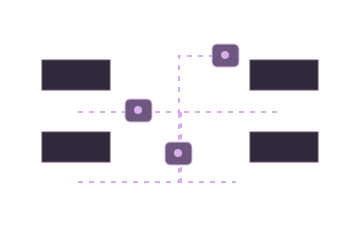
Shared traffic planning and task allocation bring a mixed robot fleet together.
- Industry
- E-commerce fulfilment
- Our role
- Fleet software & traffic management
- Core tools
- Open-RMF · ROS 2 · Fleet scheduling
A practical problem.
A growing warehouse fleet was creating congestion in narrow aisles. Separate vendor systems could not coordinate the robots, and static routes broke down whenever traffic changed.
- Engagement
- 10 months · Sep 2023–Jun 2024
- Project setting
- E-commerce fulfilment centre · Leeds
Built around the constraints.
- Plan together.
A central traffic manager reserves routes and resolves conflicts between robots.
- Connect the fleet.
Open-RMF adapters bring three different robot models into a common coordination system.
- Keep work moving.
Task allocation and charging schedules account for battery levels, distance, and congestion.
How it comes together.
Warehouse requests become coordinated robot tasks, with live fleet state feeding back into routing and allocation.
-
Dispatch
WMS API · Task allocation
Incoming warehouse jobs are assigned using task priority, robot battery state, travel distance, and congestion.
OutputPrioritised robot assignments
-
Coordinate
Open-RMF · Conflict-Based Search
Fleet planning reserves space-time corridors. Vendor adapters let different robot models share the traffic plan.
OutputCoordinated routes & reservations
-
Navigate
ROS 2 Nav2 · Local avoidance
Each robot handles its local navigation while following the fleet plan. Waiting zones help manage busy intersections.
OutputOn-robot motion & progress
-
Update
Zenoh / DDS · Fleet state
Position, task progress, and battery state return to the coordinator to inform rerouting and charging schedules.
OutputUpdated fleet state & next tasks
Results from this project.
- Robots coordinated
- 50Expanded from an initial fleet of 10
- Picking throughput
- +35%From about 800 to 1,080 picks per hour
- Robot utilisation
- 85%Compared with 60% before the rollout
Before
Separate vendor systems and static routes created bottlenecks as the fleet grew.
After
Three robot models share task allocation and traffic planning, with coordinated charging.
In context. Results cover a single facility with up to 50 robots. A dedicated network and zone-based coordination were needed as the fleet expanded.
Working on something similar?
Tell us about your system and where you need support.